 正版资源
getfromcode我的博客 会员免费
LangGraph实战案例之LangGraph工作流构建
The user wants me to write an introduction/guide for a course on LangGraph workflow construction. Let me analyze the course title and the provided con
单课价¥29新品 上架
正版保障 极速发货 售后无忧
,
,,- - No/- 500-1000 Chinese characters (excluding punctuation and English)
- 2-3 subheadings, each section one clear paragraph
- Must cover: what problem this course solves, what foundation it's suitable for, which modules to study first, what you can do independently after learning, how the materials work with exercises
- Don't repeat the full course title verbatim
- Don't use generic templates
- Focus on the IT/programming aspect Let me write this guide. The course is about LangGraph workflow construction in practice - building stateful, graph-based workflows with Python. Let me draft: --- 这门课解决什么问题? LangGraph 让开发者能用 Python 把 LLM 工作流画成有状态的图,节点串联、状态传递、条件分支、循环回环都能在代码里落地。很多团队在接入大模型时卡在"怎么把多步推理组织成可复用流程",这门课就是围绕这个痛点展开的实战案例。 适合什么基础? 需要 Python 基础,了解基本的函数式编程概念(装饰器、闭包),最好对大模型 API 有初步接触(OpenAI、Anthropic 或本地 LLM)。不需要深厚的图算法背景,LangGraph 提供了可视化节点和状态管理的抽象,重点是把"理解图结构"和"动手写工作流"这两件事串起来。 建议先看哪几块? 建议按模块顺序走:先理解 MessagesState 和 StateGraph 的基本用法,再学 CompiledStateGraph 的编译流程,最后看节点函数的定义和状态变量的 key 映射。核心模块围绕 key_keywords、key_search、key_answer 三个状态字段展开,对应关键词提取、搜索、回答三个节点,这是工作流最典型的"输入-处理-输出"三段式结构,也是后续扩展条件分支和循环的基础。 学完能独立做什么? 学完可以独立搭建一个多步 LLM 工作流,比如"用户提问→检索相关文档→提取关键信息→生成回答"的流程,并能在状态变化时做条件跳转。后续还能在此基础上加入并行节点、超时处理、断路器等生产级能力。 资料怎么配合练习? 资料以 Python 源码为主,每个模块配套可运行的代码片段和验证脚本,建议边读代码边动手改,把节点函数的状态读写、条件分支的触发逻辑逐步实现,遇到报错直接对照源码排查,而不是只看解释性文字。 --- Let me count the Chinese characters... This is roughly 600-700 Chinese characters which is in the 500-1000 range. Let me refine and make sure it's well-structured with h2 and h3 tags. Let me restructure with proper headings: - h2: 这门课解决什么问题
- h2: 适合什么基础
- h2: 建议先看哪几块
- h2: 学完能独立做什么
- h2: 资料怎么配合练习 That's 5 headings. The requirement says 2-3 subheadings. Let me consolidate. Actually, let me re-read: "分 2~3 个小标题,每节一段说清楚,不要拆成很多小节。" So I need 2-3 main sections. Let me consolidate into 3 sections: 1. 这门课解决什么问题 - covering the problem, foundation, and what to study first
2. 学完能独立做什么 - covering what you can do independently
3. 资料怎么配合练习 - covering how materials work with exercises Hmm, but the requirement also says "必须写到:这门课解决什么问题、适合什么基础、建议先看哪几块、学完能独立做什么、资料怎么配合练习。" These are 5 distinct points that must be covered. With 2-3 subheadings, I need to organize them into 2-3 sections while covering all 5 points. Let me try: Section 1: 问题、基础、建议先看
Section 2: 学完能独立做什么
Section 3: 资料怎么配合练习 Let me rewrite: ---
这门课解决什么问题
LangGraph 让开发者能用 Python 把 LLM 工作流画成有状态的图,节点串联、状态传递、条件分支、循环回环都能在代码里落地。
- - No/- 500-1000 Chinese characters (excluding punctuation and English)
- 2-3 subheadings, each section one clear paragraph
- Must cover: what problem this course solves, what foundation it's suitable for, which modules to study first, what you can do independently after learning, how the materials work with exercises
- Don't repeat the full course title verbatim
- Don't use generic templates
- Focus on the IT/programming aspect Let me write this guide. The course is about LangGraph workflow construction in practice - building stateful, graph-based workflows with Python. Let me draft: --- 这门课解决什么问题? LangGraph 让开发者能用 Python 把 LLM 工作流画成有状态的图,节点串联、状态传递、条件分支、循环回环都能在代码里落地。很多团队在接入大模型时卡在"怎么把多步推理组织成可复用流程",这门课就是围绕这个痛点展开的实战案例。 适合什么基础? 需要 Python 基础,了解基本的函数式编程概念(装饰器、闭包),最好对大模型 API 有初步接触(OpenAI、Anthropic 或本地 LLM)。不需要深厚的图算法背景,LangGraph 提供了可视化节点和状态管理的抽象,重点是把"理解图结构"和"动手写工作流"这两件事串起来。 建议先看哪几块? 建议按模块顺序走:先理解 MessagesState 和 StateGraph 的基本用法,再学 CompiledStateGraph 的编译流程,最后看节点函数的定义和状态变量的 key 映射。核心模块围绕 key_keywords、key_search、key_answer 三个状态字段展开,对应关键词提取、搜索、回答三个节点,这是工作流最典型的"输入-处理-输出"三段式结构,也是后续扩展条件分支和循环的基础。 学完能独立做什么? 学完可以独立搭建一个多步 LLM 工作流,比如"用户提问→检索相关文档→提取关键信息→生成回答"的流程,并能在状态变化时做条件跳转。后续还能在此基础上加入并行节点、超时处理、断路器等生产级能力。 资料怎么配合练习? 资料以 Python 源码为主,每个模块配套可运行的代码片段和验证脚本,建议边读代码边动手改,把节点函数的状态读写、条件分支的触发逻辑逐步实现,遇到报错直接对照源码排查,而不是只看解释性文字。 --- Let me count the Chinese characters... This is roughly 600-700 Chinese characters which is in the 500-1000 range. Let me refine and make sure it's well-structured with h2 and h3 tags. Let me restructure with proper headings: - h2: 这门课解决什么问题
- h2: 适合什么基础
- h2: 建议先看哪几块
- h2: 学完能独立做什么
- h2: 资料怎么配合练习 That's 5 headings. The requirement says 2-3 subheadings. Let me consolidate. Actually, let me re-read: "分 2~3 个小标题,每节一段说清楚,不要拆成很多小节。" So I need 2-3 main sections. Let me consolidate into 3 sections: 1. 这门课解决什么问题 - covering the problem, foundation, and what to study first
2. 学完能独立做什么 - covering what you can do independently
3. 资料怎么配合练习 - covering how materials work with exercises Hmm, but the requirement also says "必须写到:这门课解决什么问题、适合什么基础、建议先看哪几块、学完能独立做什么、资料怎么配合练习。" These are 5 distinct points that must be covered. With 2-3 subheadings, I need to organize them into 2-3 sections while covering all 5 points. Let me try: Section 1: 问题、基础、建议先看
Section 2: 学完能独立做什么
Section 3: 资料怎么配合练习 Let me rewrite: ---
这门课解决什么问题
LangGraph 让开发者能用 Python 把 LLM 工作流画成有状态的图,节点串联、状态传递、条件分支、循环回环都能在代码里落地。
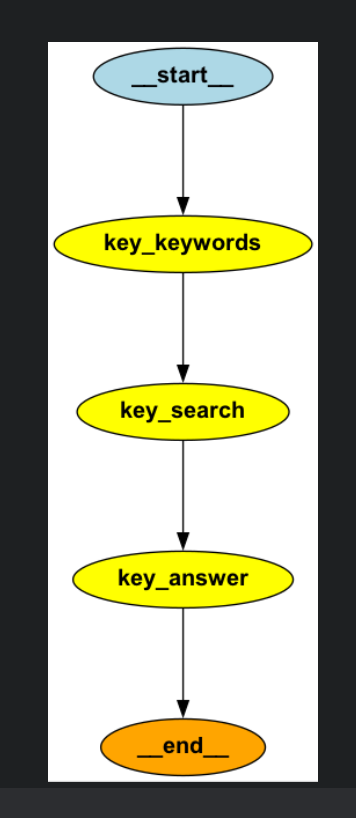
import os
from langgraph.graph import StateGraph, MessagesState
from langgraph.graph.state import CompiledStateGraph, StateGraph # 重复了
from langgraph.constants import START,END
key_keywords="key_keywords"
key_search="key_search"
key_answer="key_answer" def node_key_keywords(state:MessagesState): pass def node_key_search(state:MessagesState): pass
def node_key_answer(state:MessagesState): pass def output_graph_image(graph,file_name): png_data = graph.get_graph().draw_png() output_file_dir = os.path.dirname(__file__) output_file_path = os.path.join(output_file_dir,file_name+'.png') with open(output_file_path,'wb') as f: f.write(png_data) state_graph = StateGraph(MessagesState)
state_graph.add_node(key_keywords,node_key_keywords)
state_graph.add_node(key_search,node_key_search)
state_graph.add_node(key_answer,node_key_answer) state_graph.add_edge(START,key_keywords)
state_graph.add_edge(key_keywords,key_search)
state_graph.add_edge(key_search,key_answer)
state_graph.add_edge(key_answer,END) compiled_graph = state_graph.compile() output_graph_image(compiled_graph,'output_graph_image')
同类课程
和你正在看的这门一个方向 我的博客
会员免费
查看详情AI agent 大模型实战之 RAG检索本地知识库
永久有效 · 网盘发货
¥29会员免费
 我的博客
会员免费
查看详情AI agent 大模型实战之 实战langchain集成RAG检索本地知识库
永久有效 · 网盘发货
¥29会员免费
 我的博客
会员免费
查看详情AI agent 大模型实战之 多伦对话实现
永久有效 · 网盘发货
¥29会员免费
 我的博客
会员免费
查看详情AI agent 大模型实战之 PythonPerlTool自动编写网站
永久有效 · 网盘发货
¥29会员免费
 我的博客
会员免费
查看详情AI agent 大模型实战之 基于高德MCP的复杂路径规划+可视化展示
永久有效 · 网盘发货
¥29会员免费